

Every creative professional has heard the pitch: process kills creativity. Real design needs freedom. Inspiration does not follow a spreadsheet.
That narrative is expensive. And I believe it is wrong.
The pattern across nearly every B2B company who is scaling that we’ve worked with the situation is exactly the same. The teams producing the strongest creative work are not the ones with the most designers or the loosest briefs. They are the ones that invested in scalable infrastructure before they scaled headcount.
The Actual Cost of Running Creative Without Systems
When a design team operates without infrastructure, creativity is not what fills the gap. Production labor is, especially with the modern age of agents.
Think about what most "creative work" actually looks like at a growing B2B company without systems in place:
- Designers rebuild assets from scratch because there is no modular component library
- The same content gets reformatted manually for every channel because nothing is templatized
- Brand consistency depends entirely on individual memory instead of a system that enforces it automatically
None of that is creative work. It is repetitive execution that happens to require a designer's time. And it is the single largest drain on creative capacity at companies between $2M and $20M in revenue.
The cost is not abstract. Every hour a senior designer spends resizing social assets or rebuilding a sales deck layout is an hour not spent on the homepage redesign that will actually move pipeline. Multiply that across a team, across quarters, and the waste compounds fast.
The question worth asking is not whether your team needs more freedom or more process. It is: what infrastructure would let your creative people and agents spend 80% of their time on actual creative work instead of just 20%?
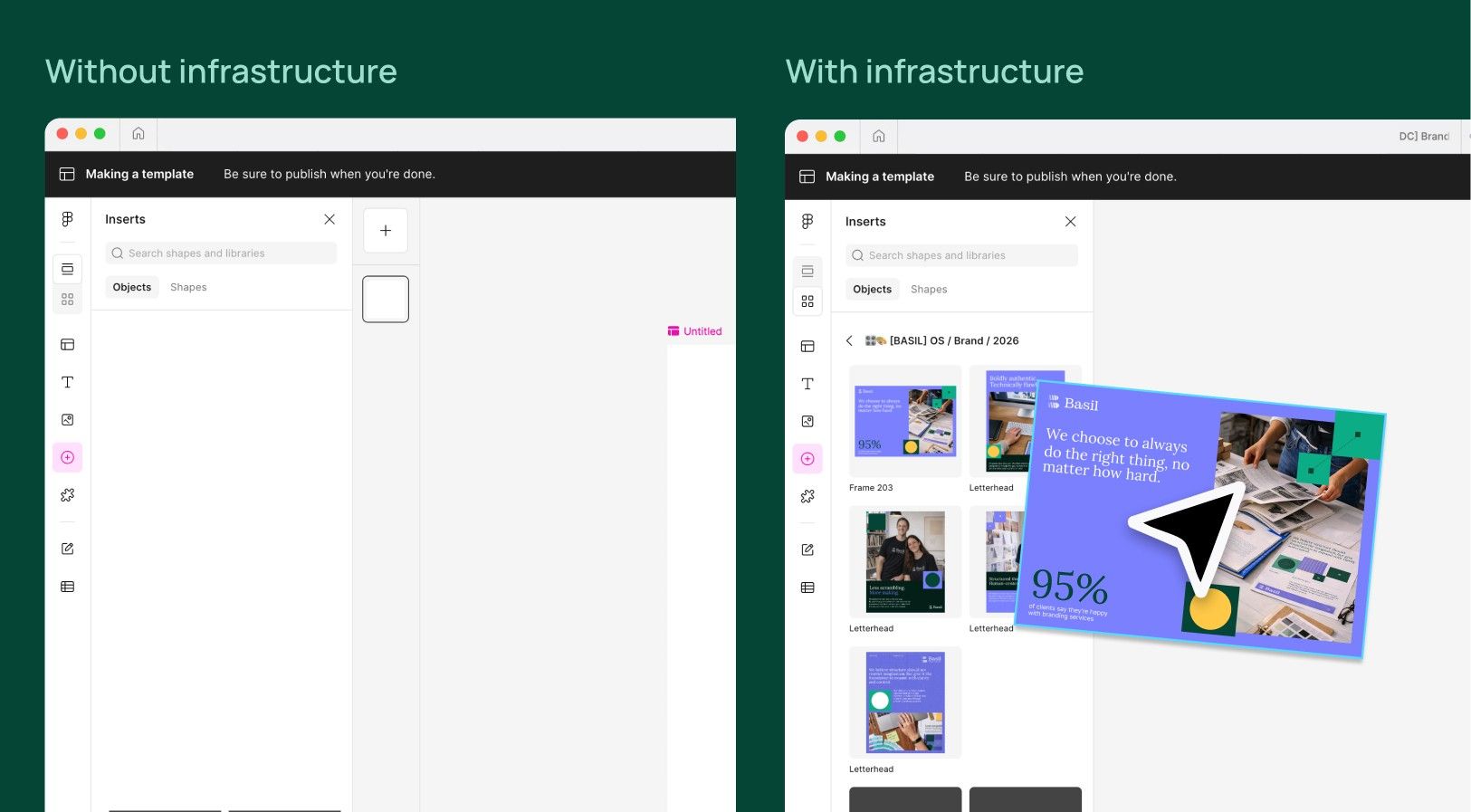
What Creative Infrastructure Actually Looks Like
At Basil Design Company , we use the term "Creative Infrastructure" to describe something specific. It is the combination of scalable brand systems, marketing-first website architectures, and operational processes that remove the bottlenecks between a creative idea and its execution.
Here is what each layer does:
Brand systems replace brand policing. A 47-page PDF brand guide that nobody opens is not a system. A modular, component-based asset library that automatically enforces visual consistency is. The difference matters because the first approach requires human oversight on every output. The second lets designers skip "does this match the guidelines?" entirely and jump straight to "what is the most compelling way to communicate this?"
Marketing-first CMS architectures replace dev bottlenecks. When your marketing team cannot publish a landing page without filing a dev ticket, your creative team becomes a production line. We architect Webflow environments where marketing teams launch pages, update content, and run campaigns independently. That single shift converts your creative team from an operational cost center into a strategic asset.
Operational processes replace context-switching. When there is no system for how assets move from concept to delivery, designers spend as much time in project management tools as they do in design tools. A clear operational layer means less time tracking work and more time doing it.
The principle across all three layers is the same: infrastructure handles repetitive scaling, humans handle creative thinking. That division of labor is what separates teams that produce exceptional work from teams that are perpetually "busy" but strategically stagnant.

Proof of Concept: Base Illustrations Informing AI at Scale
This is not theoretical. Here is how this played out with a hardware tech client of ours.
One of our amazing designers, Florence Wang , was producing custom illustrations for product documentation. Each one required technical accuracy and a hand-crafted visual style that only a skilled human could execute well.
Instead of treating every illustration as a standalone deliverable, we built infrastructure around the creative work. She created base illustrations that established the visual language, style, and technical accuracy. Those base assets then served as inputs to inform AI-assisted production for variations, alternate layouts, and scaled adaptations.
Three things happened:
- Creative quality stayed high because every core artistic decision was made by a human with domain expertise
- Production speed increased dramatically because the system generated variations from the established base instead of starting from zero each time
- Consistency became automatic because every output traced directly back to the same foundational artwork
Florence did not lose creative control. She gained creative leverage. One person's creative decisions now scaled across dozens of outputs without degradation.
This same principle applies across every service we deliver. In brand systems, core visual elements are designed by humans and then systematized for rapid on-brand asset creation. In website architecture, template systems handle standard layouts so designers focus creative energy on the pages that actually differentiate: homepages, key service pages, conversion experiences.
What This Means If You Are Scaling a B2B Company Right Now
If you are evaluating an agency, ask about systems, not just portfolios. A beautiful homepage is just the surface. The question that separates a vendor from a strategic partner is this: will your marketing team or AI agents be able to produce beautiful pages independently, at scale, six months after the engagement ends? If the answer is no, you are buying a one-time deliverable, not infrastructure.
If you are building an internal creative team, resist the instinct to add headcount when velocity drops. More designers inside a broken system does not fix the system. It makes the dysfunction more expensive. Invest in the component libraries, the CMS architecture, and the operational processes first. Then every designer and AI agent you add delivers compounding value instead of linear output.
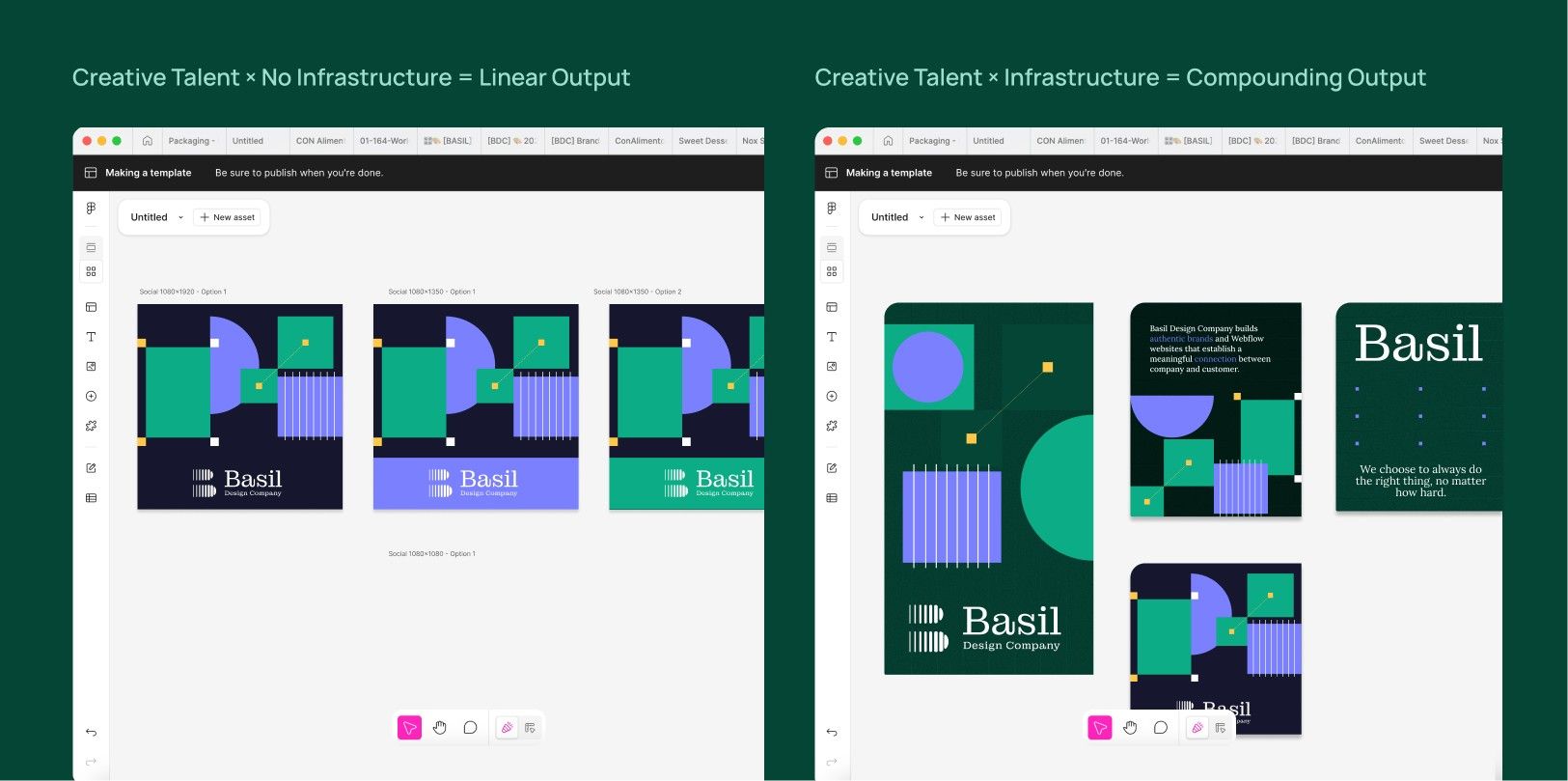
The companies that treat creative work as purely an inspiration game will keep throwing bodies at the problem and wondering why output quality plateaus. The companies that treat it as an infrastructure problem will build systems that compound over time, producing better work, faster, with fewer people.
Infrastructure is not a constraint on creativity. Infrastructure is the amplifier for it.
This article was first published on LinkedIn.

