

I see more and more people sharing the idea that AI will replace designers. This is honestly becoming true, but I think the ceiling of the level of designer it can replace has already been reached.
That level = the average level. It’s the level that might look good, but it completely lacks taste, character, and meaning which are some of the key tenants on the second half of the scale of design, truly great design. But if you can get it done with an LLM for a few bucks, why pay for a great designer or firm?
Below I want to outline what some of the risks of AI design and also where it can be very powerful for you.
How Generative AI Actually Produces Output
Generative design tools are trained on massive datasets of existing creative work. Adobe and Figma both have auto opt-in policies for all of their users. ChatGPT, Claude, Gemini, and others are all trained in similar manners. There is no filter for them to turn it on for seasoned designers and brand new ones.
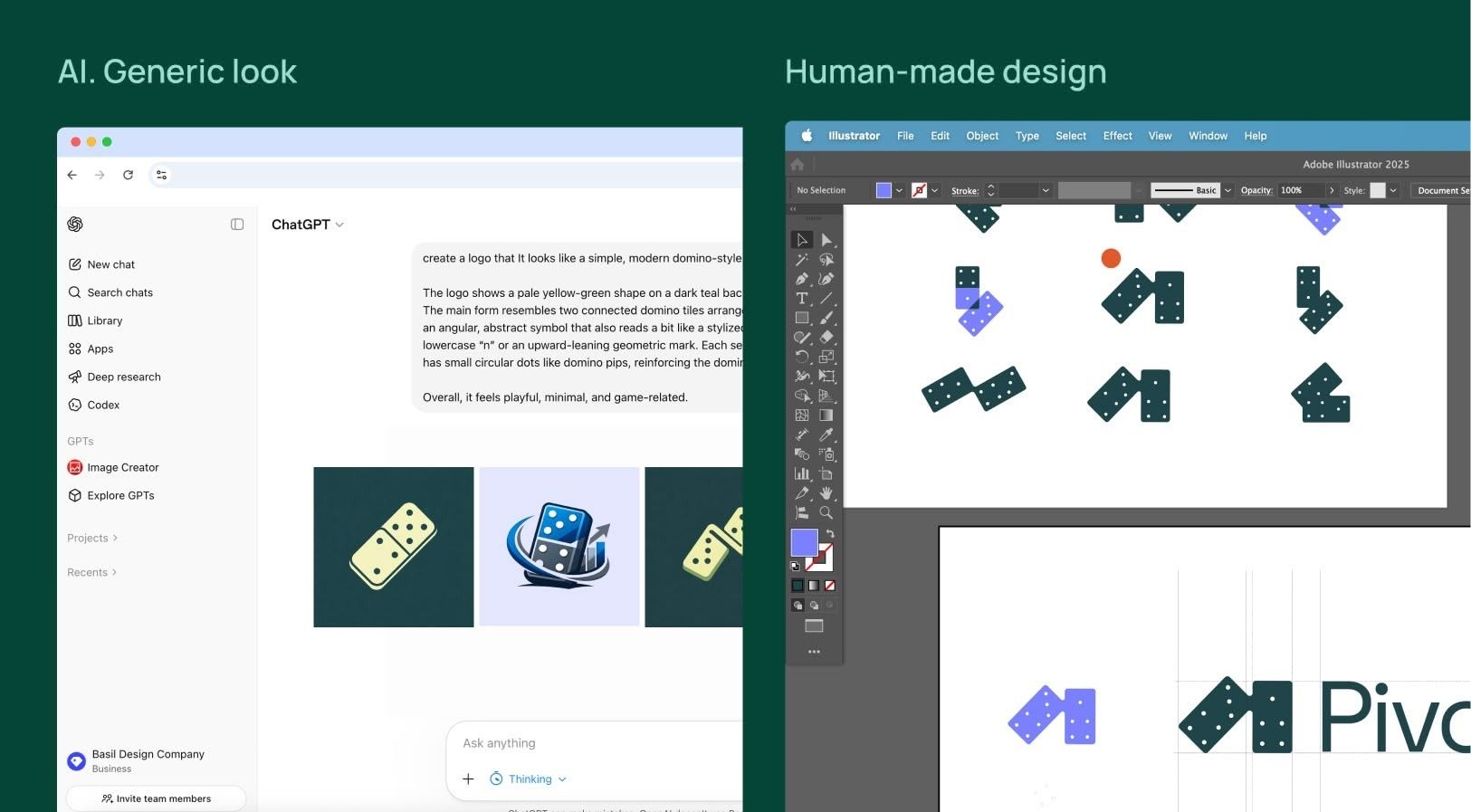
When you prompt AI to create a brand identity, it does not think about your market position, your competitive landscape, or the specific psychological triggers that will resonate with your buyer. It calculates the statistical midpoint of every brand identity and design it has ever seen.
This is quite literally how the math works. The model identifies patterns across millions of inputs and produces the output that is most probable given those patterns. The result is, by definition, the mathematical average of everything that already exists.
For generic use cases, I believe this is fine. Need a placeholder graphic for an internal deck? The average works. Need a quick mockup to test a layout concept? The average works.
But for the asset (your brand identity) that determines whether a prospect trusts your company enough to sign a six-figure contract? The average is a death sentence for even the most well planned marketing efforts and sales pitches.
The Sea of Sameness, Now Automated
B2B branding already had an averaging problem before AI entered the picture. Walk through any SaaS or hardware tech vertical and the visual patterns repeat on loop: the same gradient backgrounds, the same geometric sans-serif logos, the same stock photography of people pointing at whiteboards (thank you unsplash/pexels…).
AI did not create that problem. But it is accelerating it at a pace that should concern every marketing leader reading this.
Here is why. When every competitor in your vertical uses the same generative tools with the same default settings, the output converges toward the same center. The model pulls from the same training data. The prompts share the same language. The results share the same DNA. What used to be a slow drift toward visual commodity is now happening in weeks instead of years.
The Designer's Role Has Fundamentally Shifted
With that being said, AI is not useless for creative work. I’ve seen how AI is one of the most powerful production tools our team has ever had access to over the past 12 months. But design asset production and design direction are two entirely different functions, and collapsing them into one is where companies get burned. The key is using it for design asset production (within a workflow).
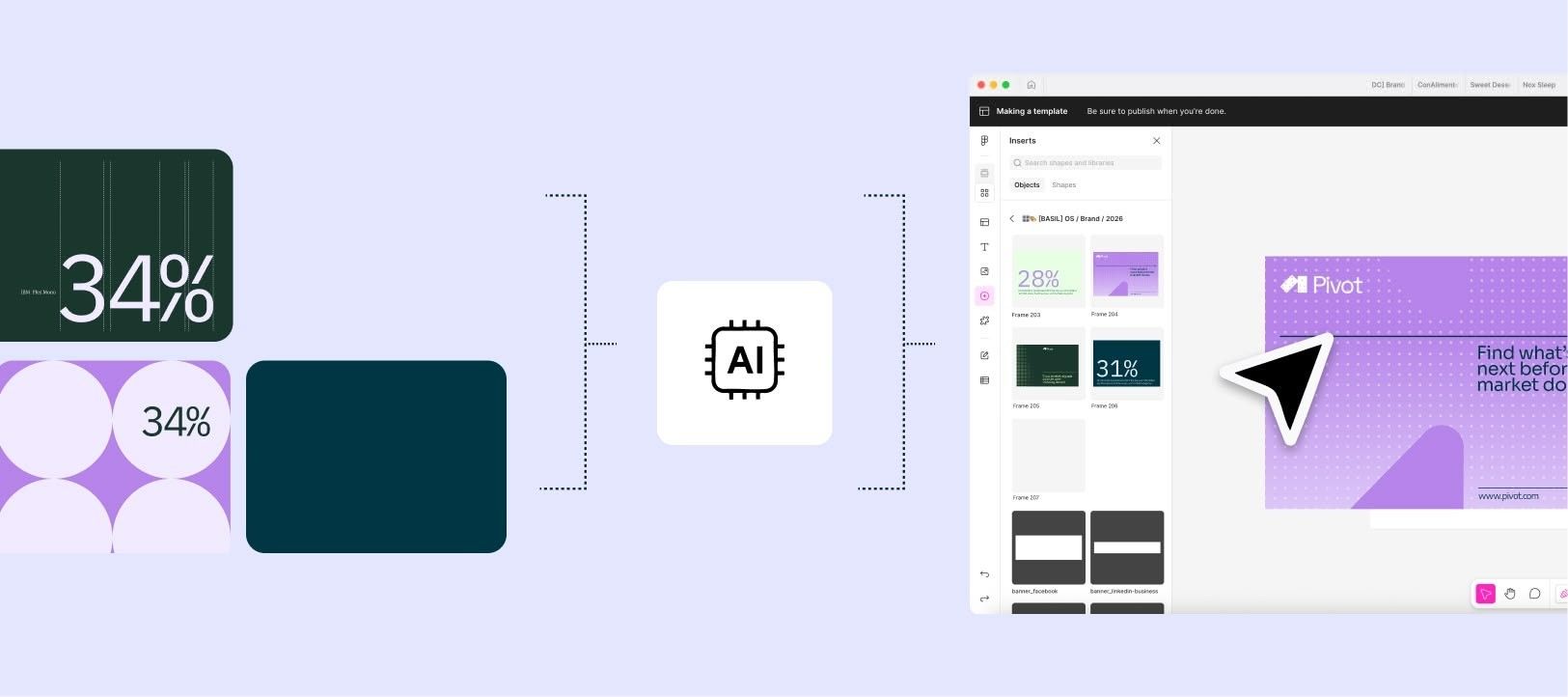
We use it to generate variations from established base artwork. We use it to scale photography libraries. We use it to QA brand assets. The list goes on. It is a force multiplier for workflows when it has something meaningful at its foundation to multiply on top of (aka design direction).
When our designer Florence Wang builds a photography system for a client's brand, she is making hundreds of micro-decisions that no model can replicate: the specific lighting temperature that matches the brand's personality, the shadow hardness that conveys the right level of authority, the scene composition variables that place products in contexts the target buyer actually relates to, the focal length and depth of field that direct attention exactly where it needs to land. She defines the entire visual language of how that brand's photography should feel. Those base parameters then become the foundation for AI-assisted generation, allowing us to scale an entire on-brand photo asset library from a set of intentional creative decisions rather than from a generic prompt.
Creative decisions should remain in people’s hands. The production labor should scale through AI. That division is what separates brands that command attention from brands that fill space.
Why B2B Is Uniquely Exposed
B2C brands can sometimes survive on volume and virality. A consumer product with a forgettable brand can still move units through aggressive paid acquisition and marketplace placement.
Long lasting B2B models do not work that way. When deal sizes are six and seven figures, every touchpoint is scrutinized. The prospect's first impression of your website, your pitch deck, your sales collateral forms an immediate judgment about whether your company is sophisticated enough to trust with a major contract. A brand that looks like a composite of your competitors does not just fail to impress. It actively signals that you are interchangeable.
I’ve primarily worked with B2B companies scaling from $2M to $20M in revenue. At that stage, the brand is often the single biggest gap between the quality of the product and the quality of the market perception. The companies that close enterprise deals consistently are not the ones with the brand built purely with AI. They are the ones with distinctive visual systems that were directed by humans who understand the strategic context of every design decision.
The Compounding Cost of "Good Enough"
The most dangerous thing about AI-averaged branding is that it looks acceptable in isolation. Any single asset passes the eye test. The logo is clean. The colors are harmonious. The typography is legible.
But "acceptable" is not what wins. "Distinctive" is. And distinction cannot be averaged into existence. It has to be directed.
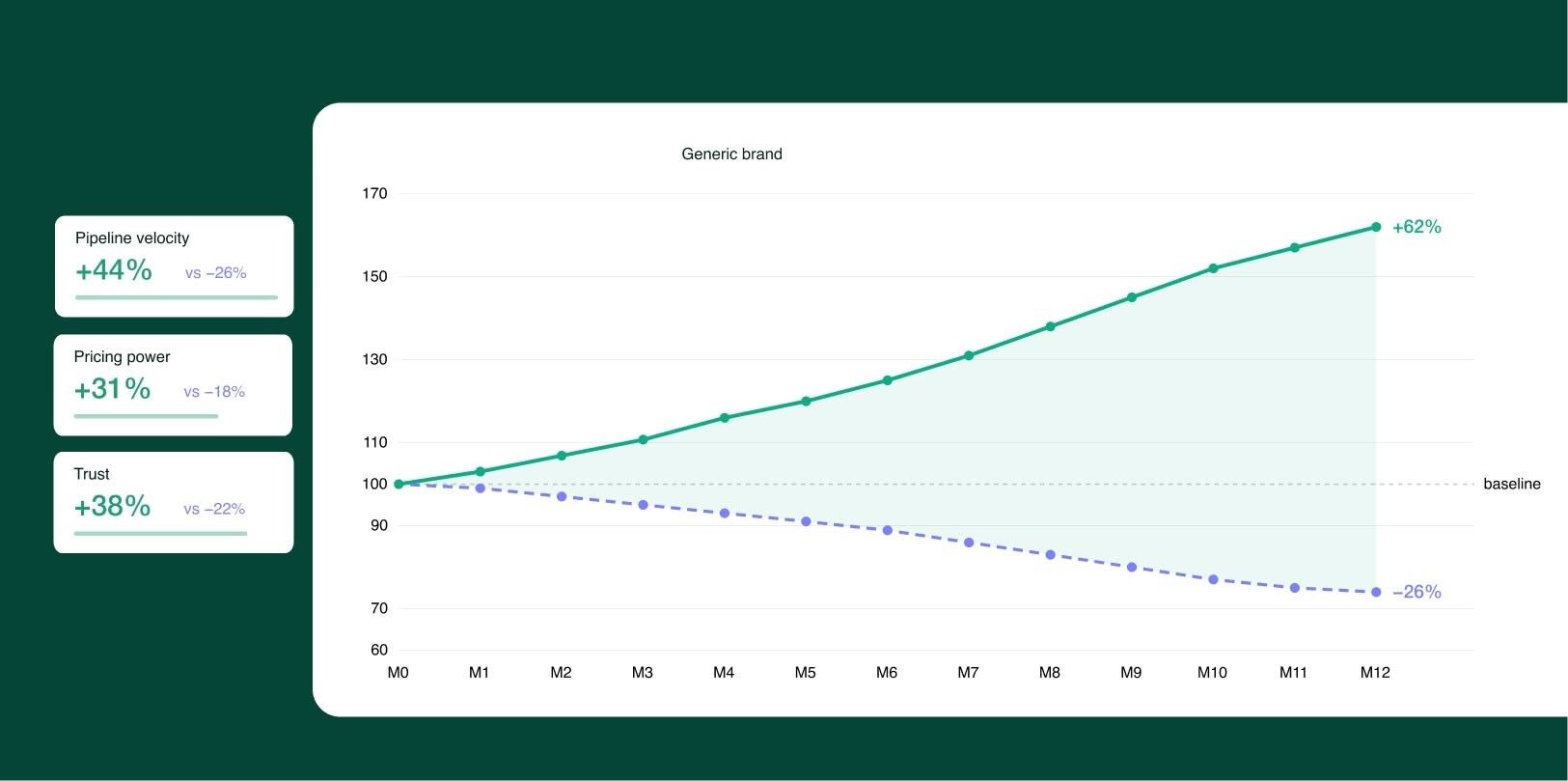
Every month a company operates with a brand that blends in, four things erode simultaneously:
- Trust diminishes because the visual presentation does not match the sophistication of the product or service being sold
- Pricing power weakens because nothing in the brand signals premium positioning, so prospects default to comparing on cost
- Pipeline velocity slows because the brand is not memorable enough to survive the gap between a prospect's first visit and their buying decision.
- The best talent ignores you because your brand is interchangeable with your competitors
What This Means for Your Next Brand Investment
AI has made creative production cheaper and faster than ever. That is genuinely valuable. But it has also made the strategic design direction layer more important than ever, because the floor of "acceptable" output has risen while the ceiling of "distinctive" output remains exactly where it always was: in the hands of people who understand your market, your buyers, and the specific visual language that will make your company impossible to ignore.
The companies that treat AI as a replacement for creative expertise will save money on production and lose it on pipeline. The companies that treat AI as a production engine backed with strategic design decisions made by professionals will build brands that compound in value over time.
The averaging machine is powerful. But your brand cannot afford to be average. And no, telling Chat that “You are an EXPERT senior brand designer with IMPECCABLE taste” does not fix the averaging problem…
This article was first published on LinkedIn.

